The main objective of this paper is to identify options of industrial development that are transformative and stand as unique contributors with high-potential for fostering sustainable economic growth, reduced carbon emissions to mitigate the threat of climate risk, and stable levels of employment opportunities through public-private partnership by fostering market-based solutions leveraging on private capital.
Given current geopolitical challenges and trade induced shocks of high US tariffs against Canadian exports, Prime Minister Carney has pledged to “oversee the biggest transformation of Canada’s economy since the end of the Second World War”. 1 This promise was followed by the One Canadian Economy Bill to remove internal trade barriers while advancing national interest projects to strengthen the Canadian economy.2 One key factor to consider is whether a project can “contribute to clean growth and help meet Canada’s objectives with respect to climate change”. The threat of climate risk and its impacts on profitability of Canadian businesses, financial institutions, and the public at large, is now an integral part of the decision calculus and, thus, requires prudent policies for mitigating measures for the country’s sustainable development.3, 4 This initiative to advocate projects that enable clean growth is well aligned with the Government’s current policy to advance Made-in-Canada sustainable investment guidelines to accelerate progress to net-zero emissions by 2050. 5
For a successful transition towards sustainable economy will require a fundamental “re-boot” of several existing industries and the development of new manufacturing enterprises that align with the domestic and global demands for low-carbon solutions. Leveraging Canada’s natural resources in this changing landscape is an opportunity for innovation and vast improvements to national productivity. These opportunities, however, have not been exploited thoroughly notwithstanding the escalated global concerns over the current weaknesses in the implementation of decarbonization strategies.6
The concept of Industry 5.0 has been regarded as the “engine of prosperity” by the European Commission to lead the industries into their green transitions, leveraging digital technologies that foster sustainability with resilience and a human-centric approach.7 Building on Industry 4.0, which emphasizes automation and efficiency with the adoption of technologies, the next phase of industrial evolution is expected to expedite digital transformation and the adoption of AI and robotics to enable smart manufacturing and intelligent supply chain management built on collaboration between humans and technology for prosperous and environmentally responsible industrial developments.8 An industrial ecosystem built on clean energies to produce its goods and services is considered a crucial foundation for such developments. A recent study by McKinsey highlights the potential additional global economic value of $3.6 trillion to $4.4 trillion annuallyi.
A Canadian national industrial strategy can be summarized as follows:
1. Industry Accelerates Adoption of Innovation in the Transport Sector to Eliminate Carbon Emissions on a Large Scale
Transportation constitutes one of the largest sources of carbon emissions in Canada, accounting for a quarter of Canada’s such emissions from cars and light trucks. Reducing the amount of transportation-related GHG emissions must continue to remain a central policy choice of all governments. The specific instruments could vary and they include provision of incentives for consumers to purchase zero-emission vehicles (ZEV) as one effective decarbonization strategy. 9, ii Canada’s 2030 Emissions Reduction Plan focuses primarily on the adoption of clean technology and complementary infrastructure for a net-zero economy. However, these financial incentives for purchasing ZEVs could only benefit the sales of foreign manufacturers if most of them are not made domestically. A simple focus on manufacturing batteries is a reasonable first step but it is neither comprehensive nor an adequate answer for a clean transport sector. A concerted effort to expand the scope and supply chains for full production of electro-mobility technologies that include cars, trucks, e-bikes, mass transit, electrification of inter-city passenger rail travel and transport of freight is necessary to open massive opportunities for industry to flourish.
Substantial improvements to the existing EV charging facilities are also imperative for cities and regions to expand their ZEV infrastructures, including charging networks, as more ZEVs are adopted, which could also create new business opportunities in investing, developing, and operating these charging networks.10 These networks can be synergistically powered by distributed renewable energy sources, such as the development of solar-powered charging stations, within Canada.
Broadly, integration of AI at all stages of mining, production and processing of Canada’s mineral resources to the manufacturing sector to the deployment and operational efficiency of all transport modes is an opportunity waiting to be exploited. An aggressive policy framework attracting foreign direct investment in Canda and nurturing new ‘off-shore’ partners is an urgent need.
2. Enhanced Incentives for Growth of Clean Technology and Renewable Energy
Clean technologies that enable renewable energy sources like solar, wind, and hydrogen are essential for reducing greenhouse gas emissions and achieving Canada’s 2030 climate goals. This emerging sector is expected to facilitate substantial job growth. The country has already formulated plans to augment the utilization of renewable energy sources for electricity power generation. For instance, Ontario has long phased out its coal-fired power facilities and now achieves 92% of its electricity carbon-free.11 Other provinces have attempted to scale up their renewable energy projects.iii Such development of renewable and sustainable energy infrastructures creates decarbonization synergies through a substantive transformation of the transport sector towards electrification.
Besides, investing in Carbon Capture, Utilization, and Storage (CCUS) technologies to decarbonize heavy industries, such as steel, cement, and oil and gas, if economically sound, could align with Canada’s 2030 Emissions Reduction Plan.12
3. Industry for A Circular Economy
The development of the renewable energy and EV sectors should embrace a circular economy approach to minimizing waste and maximizing resource efficiency in support of sustainable economic growth. For example, an innovative system for upcycling used EVs and their batteries demonstrates potential for high-value, low-emission products. Nonetheless, scaling circular economy initiatives requires widespread industry adoption, a harmonized supply chain system, and consumer behavior changes.
Canada’s rich deposits of critical minerals (e.g., lithium, nickel, cobalt) position it to become an effective global leader in battery manufacturing, recycling, and reuse, supporting the development of an integrated EV industry with renewable energy storage systems. Investments in this integrated ecosystem can create resilient supply chains and high-value jobs while reducing reliance on foreign suppliers. There are opportunities to expand the domestic production of lithium-ion battery cells and EV components, as revealed in recent business collaboration among NextStar Energy, Northvolt Batteries North America, and Volkswagen PowerCo.13 To complete such a circular ecosystem, Canada should develop recycling and circular economy initiatives for producing and recycling batteries, such as the recently proposed Umicore’s new facility in Ontario for EV battery components. In creating an exemplary sustainable supply chain for such green manufacturing, the emerging industry can enhance critical mineral refining and processing to reduce environmental impact and meet global demand for responsibly sourced materials.
4. At Scale Adoption of Digital and AI Technologies by Industry
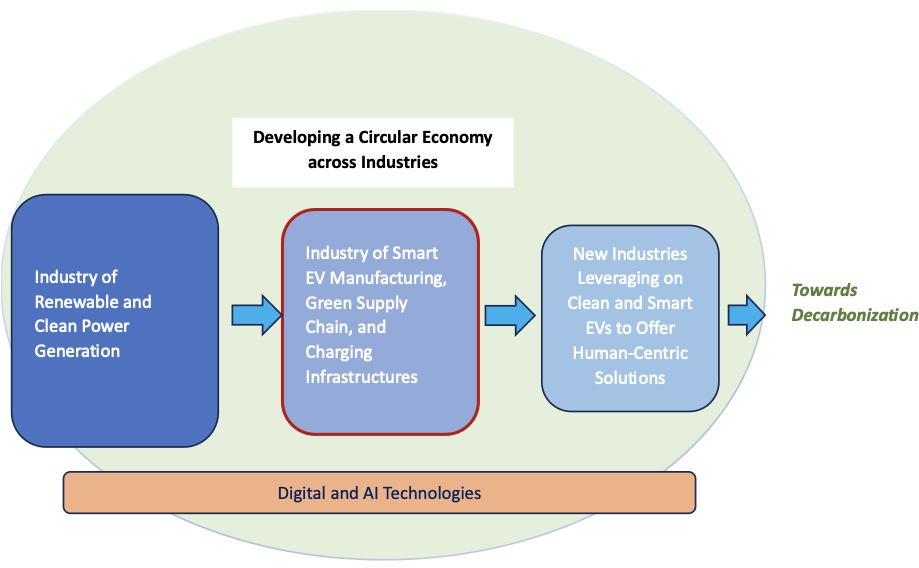
As noted above, generative AI has a huge potential for improving Canada’s national productivity. To accelerate the integration and deployment of AI capabilities advancing towards Industry 5.0, Industry 4.0 technologies, including AI and the Internet of Things (IoT), can be deployed to optimize resource use and enhance sustainability in operations across sectors.14 Specifically, AI technologies can be utilized for energy efficiency, supply chain optimization, and emissions monitoring, as illustrated in the framework of the Pan-Canadian Artificial Intelligence Strategy.15 The ongoing expansion of the digital infrastructure in Canada, such as high-speed internet to connect 98% of Canadians by 2026, as well as the rapid growth of mega data centres powered by clean energies, will be able to support the development of smart cities and sustainable businesses built on intelligent systems. Such intelligent infrastructure will enable the development of new industries, such as distributed EV charging stations across the country at strategic urban and critical locations. Empowered by this layer of intelligent infrastructures, the development of new industries to deliver advanced human-centric services and solutions will become feasible with the growing demand for digital talents.
Concluding Notes – A Holistic Approach to Industry 5.0
To conclude, there now exists a strategic opportunity to build on Canada’s natural, human capital, and technological resources, leveraging the option of developing the EV industry synergistically.
Intelligent EV manufacturing hub
EVs should be evaluated as a synergistic industry to connect renewable energies to decarbonize the transportation sector for a circular and sustainable economy. The development of intelligent EV manufacturing – from design to supply chain to production can create new and advanced jobs under the Industry 5.0 framework.
To do so, policymakers can formulate a direct investment scheme to attract a cluster of international EV industry players to create a strategic cluster to enable more technological innovation and the creation of new ventures to support the development of pertinent businesses in its overall value chain.iv, 16 Such a national scheme should be designed to encourage various models of investment collaboration, ranging from new ventures, joint ventures, to co-investment partnerships and mergers, supported and regulated by the country’s decarbonization framework.17, v
Distributed EV charging networks seamlessly powered by clean energy
EV charging stations in Canada can primarily draw power from the local electrical grid supplied by a mix of clean and renewable energy sources. These stations, as on-site renewable energy systems, can be powered by solar panels or wind turbines attached with a battery storage system, and some of them can even be equipped to generate their own electricity. Such seamlessly integrated supply of clean and renewable energy to power ZEVs will expedite the implementation of the decarbonization strategy which has been hindered undesirably (see the schematic below).
Developing and investing in innovation and new business models
Beyond manufacturing and infrastructural developments, Canada can advance to create R&D and Innovation hubs with support from both public and private funding. With respect to public funding, more research funding can be allocated to support core research on technological innovation; for instance, the University of Toronto Electric Vehicle (UTEV) Research Centre creates a university-industry partnership focusing on the development of the next generation of EV technologies as well as state-of-the-art batteries.18 Further, private funding can be attracted to support applied research on bringing in solutions for human-centric sustainability and localized solutions; for instance, Google’s Waymo project to develop a self-driving EV solution for robotaxis, green trucking logistics, and clean urban public transportation is an example of utilizing private funding for the development of new business models and potentially a new service industry supported by intelligent and green infrastructures.19
Overall, these developments for an ecosystem through a synergistic EV industry can align with Canada’s strengths, address global sustainability demands, and tackle innovation gaps, positioning the country for long-term economic and environmental resilience while addressing the noticeable concerns from the indigenous stakeholders for sustainable development.