
Introduction
Canada was shaped in the late 1890s as a nation — integrated by the “technology” of that era, the railroad. Similar to the immense impact of the railroad on Canada’s economy and capabilities in Canada’s early days, in this paper we present a transformational blueprint for Canada’s transition to a sustainable, clean energy, and a highly robust economy. The blueprint developed in this report is to help transform Canada’s energy landscape to be “fit-for-purpose” for the twenty-first century, enabling completely new sets of technological capabilities and new opportunities for high-value-add exports. Our vision is to establish “broad-based electrification” as the cornerstone of a national strategy, linked to a continent-scale ‘West–East’ power corridor. The national grid will not only serve as the backbone of Canada’s energy system but will also function as a unifying national force for the growth of new enterprises, products and services, investment and employment opportunities.
The TransCanada Power Corridor1 is a ‘national infrastructure flagship project’ — fully aligned with national priorities for sovereignty, export expansion and clean energy development. Establishing a national grid, capable of integrating all the diverse resources of each of the provinces, is a commitment to prosperity-enabling energy-security goals and balancing resource development across the energy landscape that meets Canada’s international climate obligations.
There is an urgency to shape a timely response to emerging geopolitical risks and threats to Canada's sovereignty. The necessity lies in establishing a national energy economy that can support a prosperity agenda, be resilient to the threats of climate-induced shocks, and “future proof” critical infrastructure that supports national economic growth.
Why a National Project?
Energy security and national security are the twin pillars at the core of national sovereignty. The combined diverse energy resources of each province comprise a large strategic national endowment and, when integrated into a national transmission and electricity trading system, becomes a unifying national advantage. This national advantage offers the possibilities of enhanced trade across provincial boundaries, improving Canada’s national productivity, and enabling the development of new higher value-add, exportable products and services which can support Canada’s trade diversification and broader prosperity agenda.
The unique and unifying features of a national grid are its capacity to absorb, integrate and transfer clean energy resources reliably from each of the provinces for overall national benefit through enhanced electricity trade. A national grid — co-located with the existing ‘railway right of ways’, where practical — can minimize land-use impacts and support faster permitting and approvals processes.
The pursuit of this national endeavour will require the removal of barriers to large-scale, inter-provincial electricity trade and the harmonization of regulatory frameworks. But the main prize lies in the potential for electricity to deliver a step change improvement in national economic productivity. With minimal reliance on policy instruments such as carbon tax, cap-and-trade or government subsidies, the recommendation is to focus on the displacement of oil and gas as the primary energy carrier for all sectors of the economy, with non-carbon electricity sources (such as hydro, nuclear, geothermal, wind and solar with storage, and smart grids) to deliver significant social, economic and environmental national benefits.
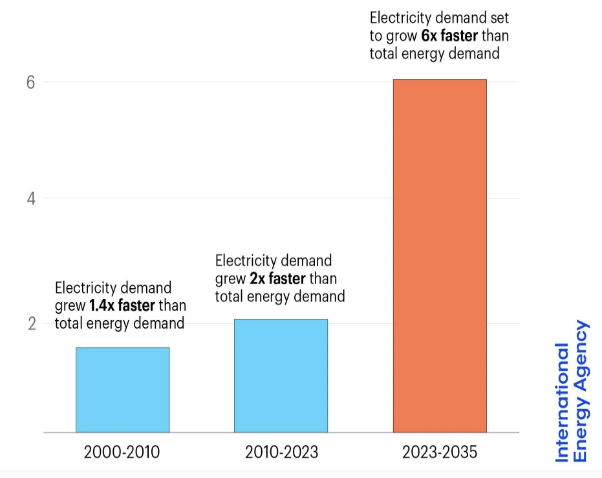
The global trend towards a massive increase in electrification is clear and well established.
Figure 1: Growth and Electricity Demand
Source: IEA (2024).
Accessed at: https://www.voronoiapp.com/energy/The-world-is-set-to-move-rapidly-into-the-Age-of-Electricity-2763#visualization
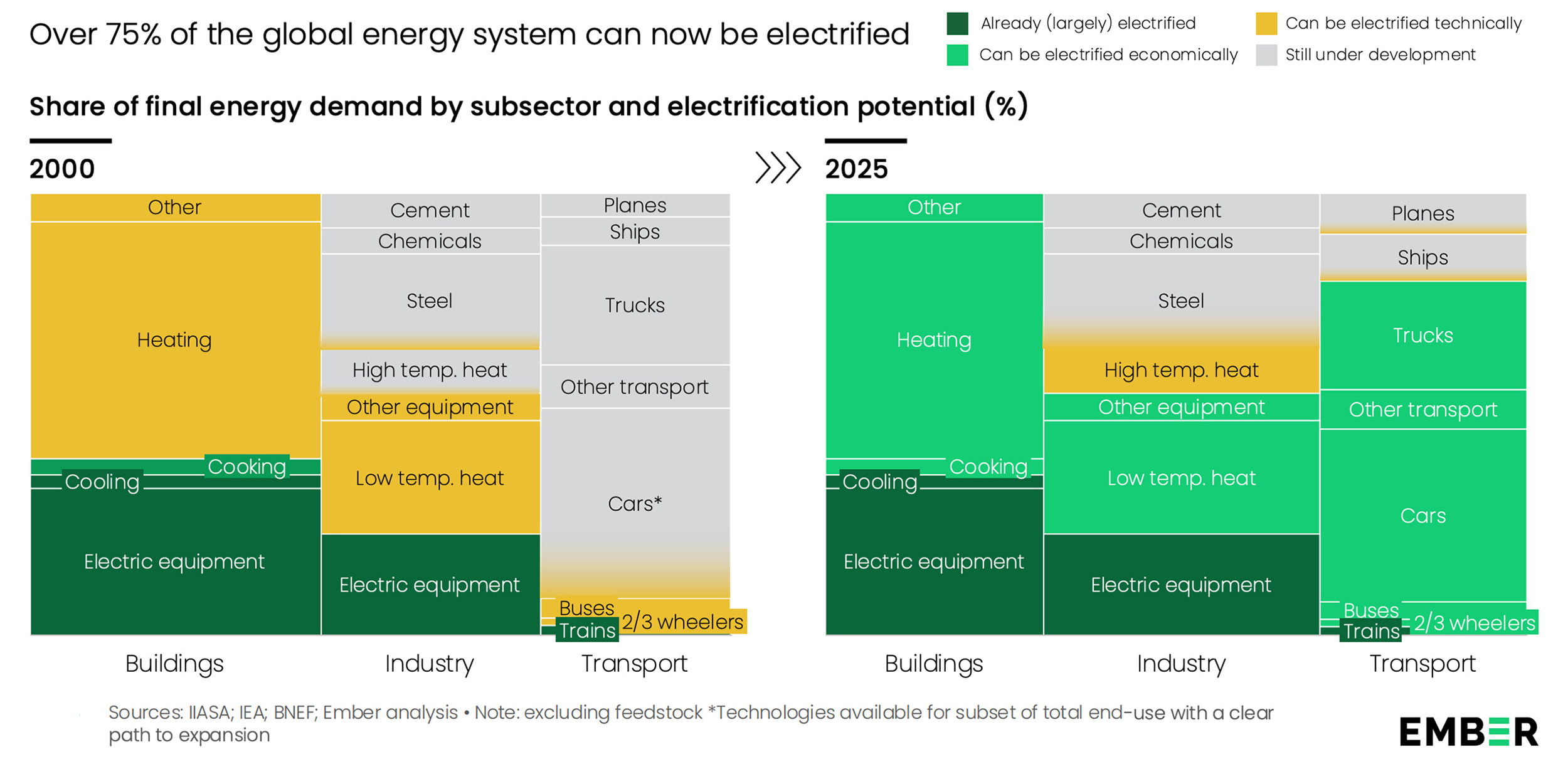
Our goal is to amplify and build on the existing advantage of Canada’s clean power grid. Accelerated expansion of the electricity sector with minimal dependence on the use of fossil fuels (<20 percent share in final energy consumption) is achievable in the 2050–2060 time frame. Timely investments in the transmission infrastructure for improved interconnection capability (2025-2035), rapid deployment of existing commercially proven technologies (2025-2040) and the development of new transformative technologies in the 2035–2050 time frame will be necessary. The strategy is to increase the share of electricity in the final energy demand to displace oil and gas as the primary energy carrier for all sectors of the economy. Primary focus is on attracting new investments in this sector with significant potential for growth, with minimal reliance on policy instruments such as carbon tax, cap-and-trade or government subsidies. Displacement of fossil fuels with non-carbon electricity generation (hydro, nuclear, geothermal, wind and solar with storage, and smart grids) combined with a large resource base of critical minerals to serve the clean technology sector is Canada’s advantage. Clean electricity delivers significant economic and environmental benefits. Electricity is a high-value manufactured product with unique flexibility providing reliable and secure access to all sectors of the economy. As shown in Figure 2 below, the potential for final energy demand to be electrified economically is over 75 percent. The goal is to amplify and build on the existing advantage of Canada’s clean power grid.
Figure 2: Potential for Final Energy Demand to Be Electrified Economically
Source: Ember (2025).
The primary source of new economic value rests on creating an “intangibles economy” enabled by access to clean, affordable electricity. Generation, transmission and intelligent distribution of electricity emerge as the backbone of a digital economy capable of accelerating artificial intelligence (AI)-enabled productivity gains for business enterprises, industry and services.
This type of transformation of the energy landscape in Canada relies on a dramatic rethinking of how electricity is generated, distributed and managed, and offers an opportunity to create a completely new set of industries and capabilities in Canada for the benefit of Canadians. The competitive national advantage shifts toward building capabilities that deliver new and sophisticated system design, engineering, manufacturing and services in support of the development and construction of an integrated national energy system that creates thousands of new high-value jobs. This national grid is a pathway to help open large export market opportunities for products and services and create opportunities for in-bound investments in the energy sector.
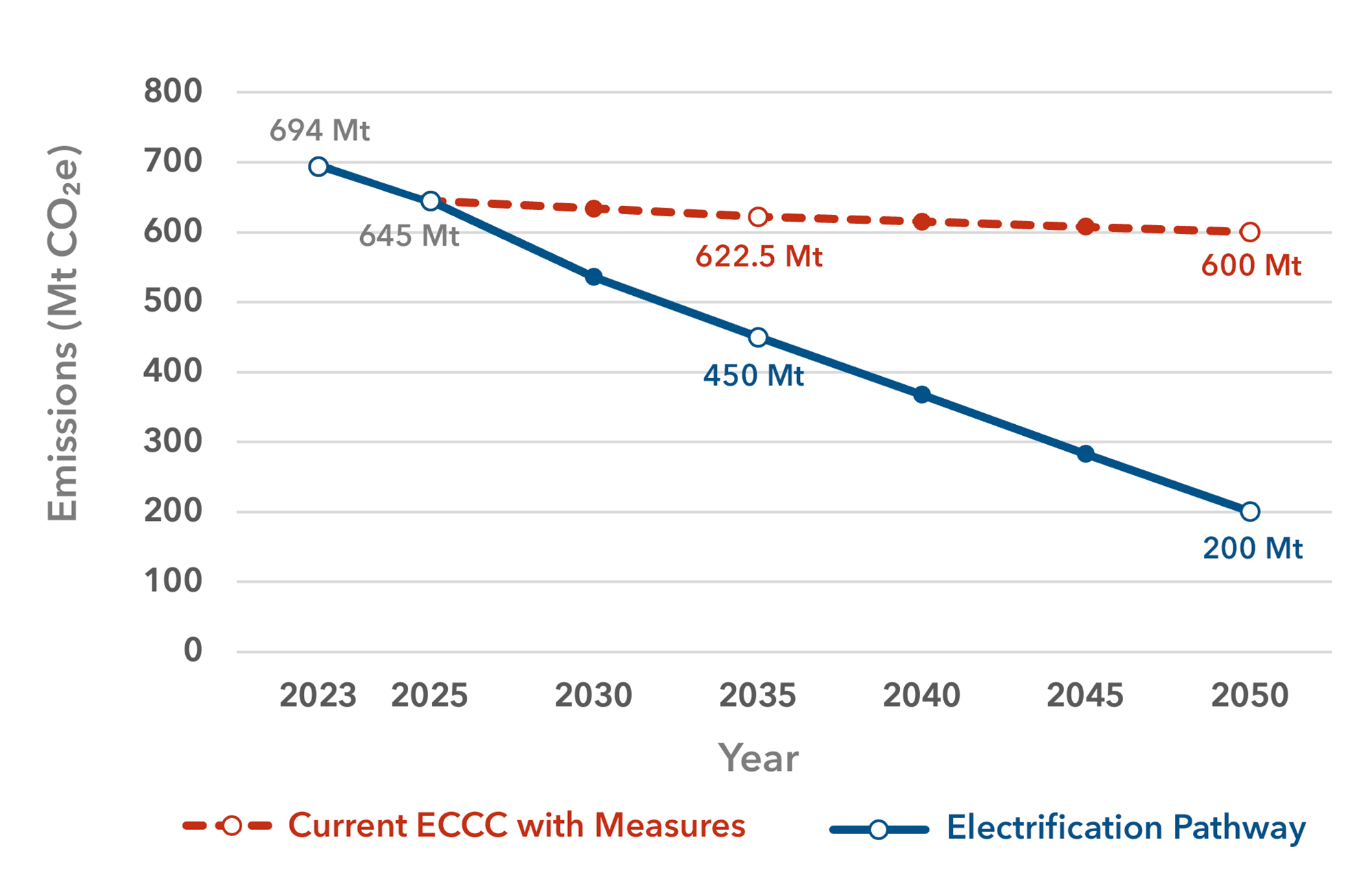
Electrification of the economy is the cornerstone of this national strategy for improving productivity and reducing the threats to sovereignty. A national grid, linking the West to the East, becomes the enabler of opportunities for enhanced trade across the provinces and the objective of minimal dependence on use of fossil fuels by 2050, and delivers on the obligations of meeting climate goals. Achieving a dramatic reduction in annual carbon emissions, greater than 70 percent, from the current level of 700 Mt to 200 Mt is feasible and aligned with the national obligations.
Figure 3: Projected Reduction of Greenhouse Gas Emissions in Canada (2023-2050)
Source: Authors.
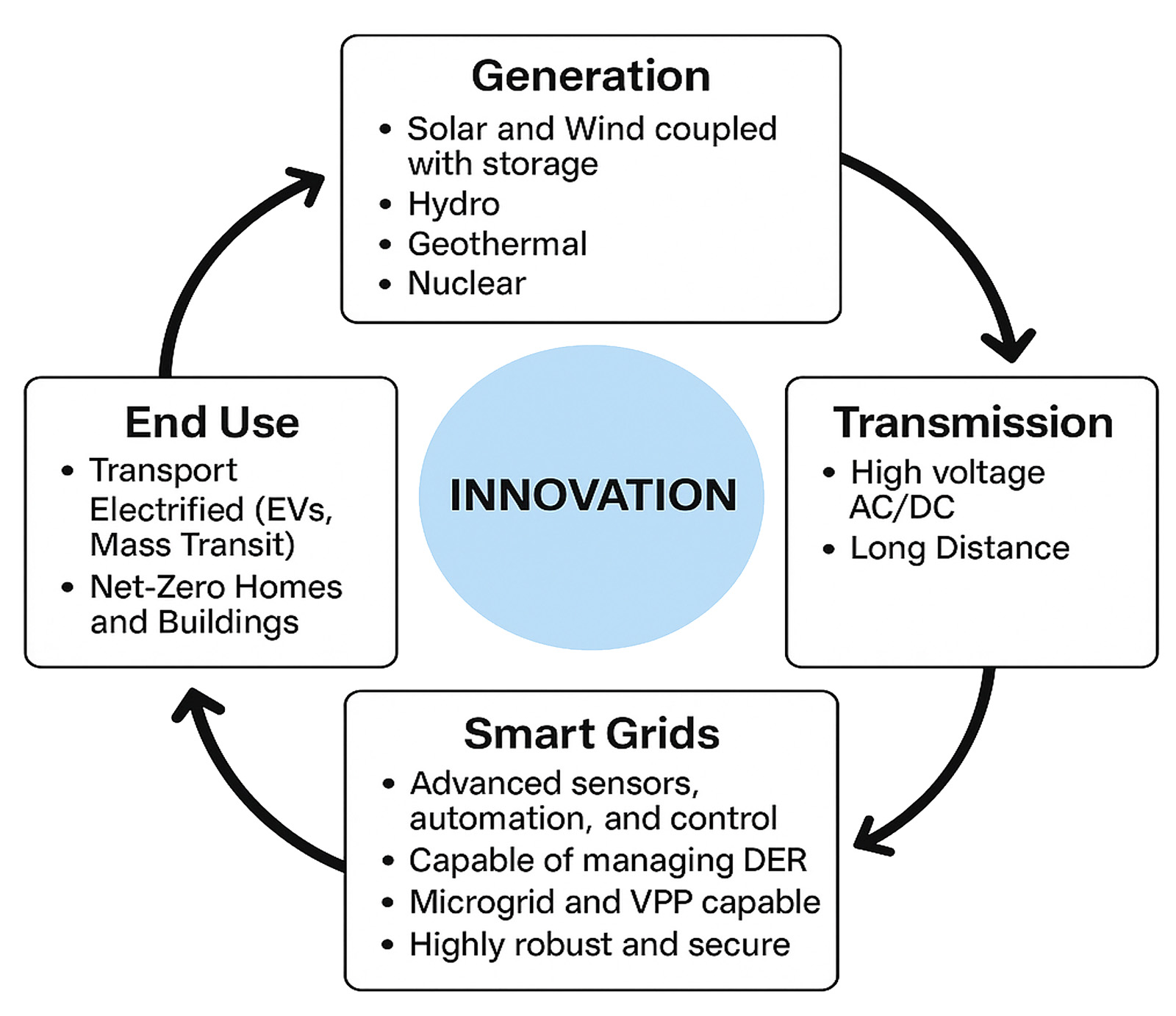
The basic building blocks for the transformation of the energy landscape that offer a clear pathway for cost-effective displacement of oil and gas with electricity are shown in Figure 4 below. The core elements of a clean energy system comprise generation linked by transmission of electricity (high-voltage direct current [HVDC] or alternating current [AC]) over long distances along a west–east national corridor combining different forms of electricity generation across provinces as inputs into the national grid. The national grid serves as the backbone for fully and effectively utilizing each province’s resource base, enabling trade, seamless interprovincial transfers and the balancing of supply and demand across Canada’s interconnected networks. This is technically feasible and has been demonstrated over the past six decades in the operation of the existing system, although currently, the flows are north–south to US markets.
Figure 4: Flow Diagram Demonstrating an Innovative Pathway
Source: Authors.2
This blueprint is a re-imagination of Canada’s energy landscape relevant to the context of our times requiring a five-fold increase in the installed electricity capacity from 80GW (2025) to 400GW (2050) resulting in a decrease of carbon emissions from 700 Mt to 200 Mt. The report offers a window to a new paradigm in which other nations will also begin to recognize Canada as a subject matter expert in these transformational energy projects – national benefits side, this in turn will greatly support Canada’s national goals of opening large export market opportunities in clean electricity generation and transmission technologies and services based on home-grown intellectual capital and capabilities.
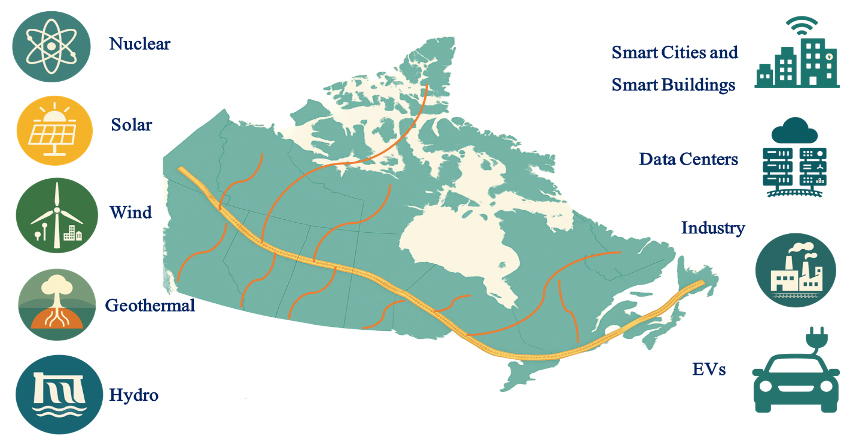
This TransCanada Power Corridor (Figure 5) linking all provinces and regions of Canada from the West to the East, is an integral part of a transformation to enable the seamless flow of energy trade through electrification. For substantial social, economic and political benefits of a unified country to be realized, development of this corridor is of national urgency.
Figure 5: TransCanada Power Corridor
Source: Authors.
SUMMARY
TransCanada Power Corridor: A National Grid Uniting Canada
This report has developed a vision for reimagining the architecture of Canada’s energy landscape enabled through the development of a west–east power corridor – a national grid – that links all the provinces and regions of Canada as part of seamless flow of energy trade through electrification. This can only be accomplished by reducing fragmentation across provincial jurisdictions as part of a whole-of-government, whole-of-society approach. If substantial social, economic and political benefits of a unified country are to be realized, then Canada must treat the TransCanada Power Corridor as a project of national urgency, akin to the construction of the transcontinental railway in the nineteenth century.
Highlighted below are the report’s “Conclusions” and “Recommendations”. Specifically, the recommendations address the challenges of political considerations, governance, regulation, trade and finance.
Conclusions
- The TransCanada Power Corridor links the entire continent from the West to the East and represents more than an energy project; it is a nation-building enterprise that fuses economic prosperity, climate security, energy sovereignty, and digital independence into a single strategic vision. Its success depends not only on technical feasibility but also on urgent and collaborative governance, the recognition of electricity as a strategic trade asset, and the establishment of a robust financial architecture aligned with national purpose.
- Canada’s prosperity and sovereignty are best secured by re-imagining the national energy landscape with a west–east TransCanada Power Corridor – a national electricity grid – for energy transfers across provincial boundaries.3 High-voltage (DC or AC) transmission towers, co-located where practical with rail/highway right of ways, serve as the backbone of an electrified energy economy fit-for-purpose for the twenty-first century.
- One consequential impact is a massive fivefold increase in electricity demand from ~700 TWh (2025) to ~1,950 TWh (2035) and ~3,550 TWh (2050), with installed capacity expanding ~80 GW to ~220 GW and, finally, ~400 GW.
- Success is contingent on timely investments in the necessary infrastructure and a focus on rapid deployment of clean electricity generation and transmission technologies. The building of a national power grid unlocks mutual benefits: a 10 to 20-fold increase in interprovincial electricity trade, balancing diverse provincial resource endowments (hydro, nuclear, geothermal, wind, solar with storage) and the creation of an energy system focused on electricity trade across Canada away from today’s balkanized, north–south oriented flows. Beyond the high value technologies which sit beneath the new forms of electrified power – and the enhanced levels of productivity achieved - the support that this new West-East infrastructure can offer to Canada’s new prosperity agenda, and the production of Canadian-made, high value, exportable products and services, also serves as a critical contribution of this project.
- The end-state goal by 2050 is an energy economy with a share of clean electricity at 80 percent in total final energy consumption, which has the potential for eliminating ~8,500 PJ of oil and gas requirements from current consumption and enabling a decisive reduction in carbon emissions from the current levels of 700 Mt to 450 Mt in 2035 and 200 Mt in 2050.
- Historical evidence shows that electricity has delivered higher GDP per unit energy than fossil inputs. Electrification embodies not only an effective climate strategy, but also provides an overall economic growth strategy for improving national productivity. It is an investment strategy for the provision of abundant, clean, affordable electricity as the critical input for driving growth of the intangibles economy (AI, digital services, advanced manufacturing processes and technologies).
- As an enabler of an energy transition to deliver a clean energy future, the national grid will require expansion of transmission capacity within each province (high-voltage DC/AC lines, modern substations and digital controls to manage grid reliability) and new interconnection facilities. Situating the power corridor along rail/highway corridors – where practical – is a strategy to minimize land-use conflicts and accelerate permitting and community engagement.
- For power generation, four main building blocks are highlighted for system expansion. These building blocks draw upon the existing resources and strengths within each province: hydro, nuclear, wind and solar with storage, and geothermal energy resources (shallow and deep). A “smart gas strategy” will be necessary for grid support, peaking requirements and optimization of intermittent generation.
- To meet the challenges of a massive increase in generation capacity (2035-2050), several transformative generation options have been identified that are not currently included in the system expansion plans of the provinces. These illustrative examples will require further analysis, but offer pathways for future development:
- A long lead time, high-impact opportunity for further evaluation of the Mackenzie River Hydroelectric complex with a capacity of ~13,000 MW capable of producing ~92 TWh/yr to support decarbonization goals for Alberta and Saskatchewan.
- Advanced nuclear technologies that can complement existing renewable resources and with new reactor designs (SMRs) that can provide reliable, low-carbon baseload electricity to support the electrification of transport, heating and industry.
- Advanced industrial innovation to leverage the drilling and geological expertise and know-how of the Alberta oil-and-gas sector for the cost-effective utilization of enhanced geothermal system for base load electricity generation allowing a global level scale-up of deep rock geothermal energy extraction.
- The Province of Saskatchewan offers a unique Canadian advantage to transition from uranium mining to full-scope provision of nuclear services including fuel fabrication to re-use nuclear waste for electricity generation and to close the nuclear fuel cycle without geological disposal.
- Wind and solar technologies are now cost-effective established energy resources. Indeed, multiple studies have confirmed solar energy is the least expensive source of new electricity generation (IEA 2024). Further economic value will be harnessed through integrated large-scale storage capable for delivering firm dispatchable power.
- The suite of solutions on the customer demand side is highlighted, and includes smart grids as enablers of smart urbanization to help reduce cost and risk. Aspects of this strategic development include targeting electrified transport, building retrofits, two-way smart grids and ICT-enabled demand response to flatten peaks, improve reliability and ensure affordability.
- A strategy that includes growth of a durable service sector (the intangibles economy) with deployment of AI will spur productivity uplift across industry and services.
Recommendations
Governance and Regulation
The harmonization of provincial regulatory approaches with an overlay of a national framework for enhanced trade in electricity as bi-directional flows through the TransCanada Power Corridor‘ will be critical to the realization of benefits for all Canadians.
Building on established approaches to collaborative federalism, the further development of a structured partnership between federal, provincial, territorial, Indigenous and municipal governments - supported by private industry, unions, civil society and academic institutions – will be necessary. Without such collaboration, constitutional disputes over natural resource jurisdiction and infrastructure approval processes will delay progress and erode public confidence.
In this spirit, it is recommended that a National Energy Infrastructure Council be established under the aegis of the recently announced Major Projects Office or, alternatively, the Canada Energy Regulator. The Council, chaired by the prime minister, could become a single point of focus for convening premiers, Indigenous leadership and industry stakeholders for binding decisions.
The Corridor must be framed, not as a discretionary option, but as a project of national importance for integrating economic prosperity, energy security, climate resilience, national security and sovereignty.
Electricity Trade as National Strategic Asset
The primary goal of a west–east corridor is to reverse the historic dependence of north–south flows of trade in electricity by creating a robust internal market capable of absorbing any surplus generation in any one province and distributing it efficiently across provinces. This provides Canada with a clear pathway for linking energy security with prosperity, national security and sovereignty, and a capacity to insulate Canada from future geopolitical trade disputes.
In addition, enhanced electricity trade across Canada increases leverage, positioning Canada as an indispensable clean-power supplier in North America. It also increases global export capacity enabling liquefied hydrogen, green steel and critical-mineral processing powered by Canada’s low-carbon electricity to compete internationally.
Just as wheat, oil, and minerals underpinned past national growth, abundant clean electricity must now become Canada’s twenty-first century comparative advantage.
Finance: Aligning Capital with National Purpose
A transformative end-state vision for 2050 described in this report will require investment in infrastructure in the order of billions of dollars in capital in the 2025-2050 time frame. The scale of the change proposed cannot be funded solely through traditional ratepayer models.
A national financial architecture must be designed to attract private and institutional capital while ensuring public accountability. Several options exist that require further consideration and could include the following:
- establishing a Canada Clean Infrastructure Sovereign Fund, capitalized through federal green bonds and co-investment from the Canada Pension Plan Investment Board and major provincial funds;
- mobilizing public-private partnerships, but with safeguards against foreign capture of critical infrastructure;
- creating a pan-Canadian green finance taxonomy, aligned with EU and Organisation for Economic Co-operation and Development standards, to attract global capital markets while preserving domestic oversight; and
- leveraging carbon border adjustment mechanisms in trade agreements to finance corridor expansion by tying Canadian exports to verifiable clean-energy inputs.
Any combination of the approaches outlined above allows flexibility to move away from reactive taxation and introduces a focus on market approaches for sovereign financing.
Final Conclusions
Canada can reduce its dependency on fossil fuels, US energy markets and foreign digital infrastructure by advancing broad-based electrification of the economy. It can position itself as a global middle-power leader in climate, energy and digital governance. The west–east power corridor is a constitutional project of our time – an indispensable step towards a sovereign, sustainable and resilient Canada in 2050.
This can only be accomplished, however, by reducing fragmentation across provincial jurisdictions as part of a whole-of-government, whole-of-society approach. If substantial social, economic and political benefits of a unified country are to be realized, then Canada must treat the west–east power corridor as a project of the utmost national urgency, akin to the construction of the transcontinental railway in the nineteenth century.
With a timely commitment to the TransCanada Power Corridor as enabler of clean electricity trade and transfers across provincial boundaries, Canada can future-proof its economy and decarbonize decisively.
Work Cited
Ember. 2025. Slidedeck: The Electrotech Revolution. September. https://ember-energy.org/app/uploads/2025/09/Slidedeck-The-Electrotech-Revolution-PDF.pdf.
Acknowledgments
The authors would like to acknowledge the valuable feedback and helpful insights provided by the reviewers and colleagues. We are truly thankful to the following: Steve Orsini (COU), Professor Shariyar Nasirov (Universidad Adolfo Ibanez, Chile), Barry Appleton (BSIA scholar and Appleton Associates, Toronto), Professor Sidhu Tarlochan (Ontario Tech University), Professor Madjid Soltani (BSIA Fellow and International Business University, Toronto), Professor Neil Craik, (University of Waterloo).
The authors also acknowledge the strong support and mentorship provided by Ann Fitz-Gerald, Director, BSIA.
Professor Nathwani acknowledges the financial support of National Science and Engineering Research Council (NSERC), University of Waterloo, Department of Management Science and Engineering, Discovery Grant RG PIN-2023-03314, October 2023.
Authors

Jatin Nathwani is Professor Emeritus, Department of Management Science and Engineering, University of Waterloo, a BSIA Fellow and Technology Governance Initiative Fellow, and Founding Executive Director, Waterloo Institute for Sustainable Energy (WISE). Professor Nathwani is one of Canada’s foremost experts and thought leaders on sustainable energy policy and technology governance. He has held leadership positions at the University of Waterloo and advised government, business, academic and civil society organizations. He has made significant contributions to the development of science in support of sustainable energy policy, capacity building, and community-building, all in support of transitioning global and national energy systems towards more just and sustainable outcomes.

Kam Mofid is a Balsillie School of International Affairs Fellow. He has been a senior executive and a thought leader in solar energy and energy electrification since 2010 and has led multiple large solar energy and technology companies both in the United States and globally through periods of rapid growth and substantial market changes. Prior to his tenure in clean energy, he held senior leadership positions in the automotive and aerospace sectors at General Motors, Teleflex, and Pratt & Whitney. Kam holds engineering degrees from the University of Waterloo, Canada and the Georgia Institute of Technology in Atlanta, Georgia, USA.

Georgia Goodwin is currently a Research Associate at the University of Waterloo. She recently completed her Honours B.A. degree at McGill University, concentrating on comparative political studies in the energy sector. Her thesis examined how Canada could adapt Norway’s oil wealth management model to build a sustainable and equitable energy future.
Endnotes
1. The TransCanada Power Corridor will emerge from an integration of regional grids — reflecting geography and existing system configurations in the West, Central and Eastern parts of Canada — connected at key nodal points for seamless transfers of electricity trade, reliability enhancements and security of the national system.
2. Distributed Energy Resources (DER)
3. The TransCanada Power Corridor is envisaged as an integration of three regional grids (West, Central, East) linked through inter-connections across provincial boundaries.