
Executive Summary
[types field='brief-author-role'][/types]
Canada was shaped in the late 1890s as a nation — integrated by the “technology” of that era, the railroad. Similar to the immense impact of the railroad on Canada’s economy and capabilities in Canada’s early days, in this paper we present a transformational blueprint for Canada’s transition to a sustainable, clean energy, and a highly robust economy. The blueprint developed in this report is to help transform Canada’s energy landscape to be “fit-for-purpose” for the twenty-first century, enabling completely new sets of technological capabilities and new opportunities for high-value-add exports. Our vision is to establish “broad-based electrification” as the cornerstone of a national strategy, linked to a continent-scale ‘West–East’ power corridor. The national grid will not only serve as the backbone of Canada’s energy system but will also function as a unifying national force for the growth of new enterprises, products and services, investment and employment opportunities.
The TransCanada Power Corridor is a “national infrastructure flagship project” — fully aligned with national priorities for sovereignty, export expansion and clean energy development. Establishing a national grid, capable of integrating all the diverse resources of each of the provinces, is a commitment to enhanced energy-security goals and balancing resource development across the energy landscape that meets Canada's international climate obligations.
There is an urgency to shape a timely response to emerging geopolitical risks and threats to Canada's sovereignty. The necessity lies in establishing a national energy economy that is resilient to the threats of climate-induced shocks and to “future proofing” critical infrastructure that supports national economic growth. The global trend towards a massive increase in electrification is clear and well established. The goal of this report is to amplify and build on the existing advantage of Canada’s clean power grid. Accelerated expansion of the electricity sector with minimal dependence on the use of fossil fuels (<20 percent share in final energy consumption) is achievable in the 2050–2060 time frame. Timely investments in the transmission infrastructure for improved interconnection capability (2025-2035), rapid deployment of existing commercially proven technologies (2025-2040) and development of new transformative technologies in the 2035–2050 time frame will be necessary. Achieving a dramatic reduction in annual carbon emissions, greater than 70 percent, from the current level of 700 Mt to 200 Mt is feasible and it meets the national obligations. The focus in this report is primarily on attracting new investments in this growth sector, with minimal reliance on policy instruments such as carbon tax, cap-and-trade or government subsidies.
Figure 1: Growth and Electricity Demand
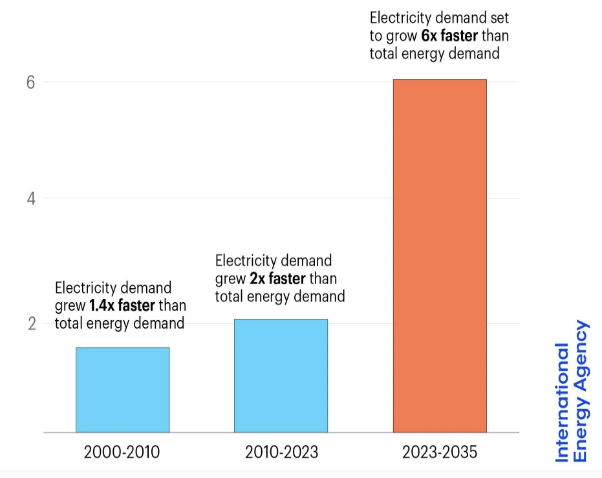
Source: IEA (2024).
Accessed at: https://www.voronoiapp.com/energy/The-world-is-set-to-move-rapidly-into-the-Age-of-Electricity-2763#visualization
The unique and unifying features of a national grid are its capacity to absorb, integrate and transfer clean energy resources reliably from each of the provinces for overall national benefit through enhanced electricity trade. A national grid — co-located with the existing railway right of ways where practical — can minimize land-use impacts and support faster permitting and approvals processes. Accelerated displacement of fossil fuels with non-carbon electricity generation (hydro, nuclear, geothermal, wind and solar with storage, and smart grids) and a deep resource base of critical minerals for the end-use sector are Canada’s advantage. The strategy is to increase the share of electricity in the final energy demand to displace oil and gas as the primary energy carrier across all sectors of the economy. Clean electricity, as a high-value manufactured product, delivers measurable economic and environmental gains while providing a uniquely flexible, reliable, and secure access to energy for all end uses.
Figure 2: Increase in Electricity Demand by Sectors, 2024–2030
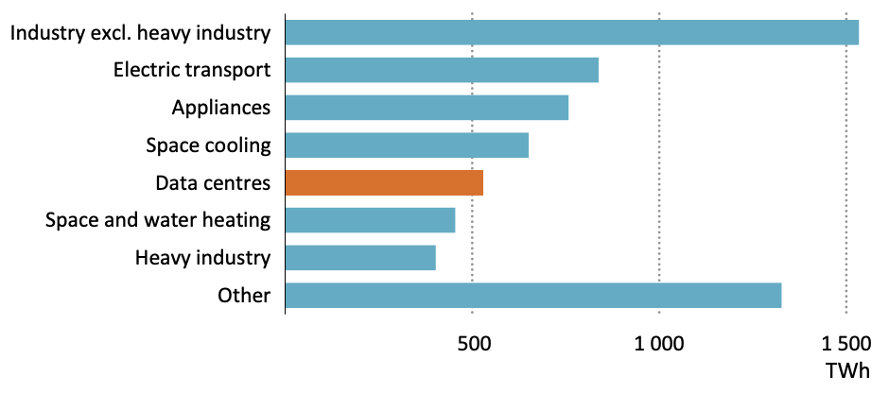
Source: IEA (2025).
Generation, transmission and intelligent distribution of electricity emerge as the enablers of a digital economy capable of accelerating artificial intelligence (AI)-enabled productivity gains for business enterprises, industry and services. The hardware, software and service offerings that drive the intangibles economy will remain integral to this new energy landscape, positioning Canada as a global powerhouse of innovation and technological prowess.
Transforming Canada’s energy landscape requires a dramatic rethinking of how electricity is generated, distributed and managed through existing regulatory frameworks in each province. Bold thinking is the first step in the creation of a completely new set of industries and capabilities in Canada for the benefit of Canadians. The national competitive advantage shifts towards building capacity that delivers innovative, new and advanced system design, engineering, manufacturing, and operation and maintenance capabilities in support of the development and construction of this national, clean integrated energy system.
This blueprint focuses on the question: “What future do we want to create?” to develop the necessary capabilities that will not only result in the creation of thousands of high-value new jobs but will also ensure other nations recognize Canada as a subject-matter expert in these transformational energy projects. The broader national goals of opening large export market opportunities — both products and services — in clean energy generation and the primary role of electricity in the intangibles economy aligns strongly with the urgency of developing a national power grid.
This vision of the TransCanada Power Corridor, linking all provinces and regions of Canada from the West to the East, is an integral part of a national grid to allow the seamless flow of energy trade. This aspirational goal can only be achieved as part of a “whole-of-government, whole-of-society approach” requiring accelerated permitting and regulatory clarity. For substantial social, economic and political benefits of a unified country to be realized, development of this corridor is of utmost national urgency. Although the aspirational goal is a linked power corridor across Canada, a practical emergence of the concept will be through regional grids (West, Central and East) connected at key nodal points for maintaining system security and to allow seamless flow electricity for trade. This report highlights key recommendations for future work to address significant challenges of governance, regulation, trade and finance.
Figure 3: TransCanada Power Corridor
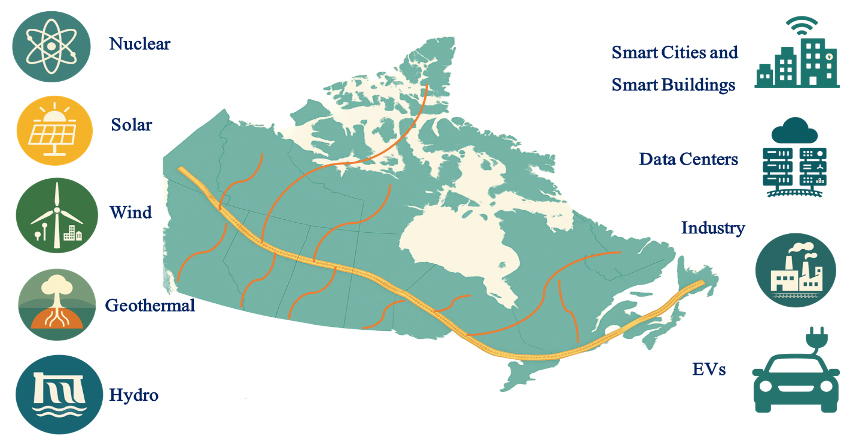
Source: Authors.
Table of Contents
Acronyms and Abbreviations
Executive Summary
Introduction
Why a National Project?
Canada’s Energy System at a Crossroads
A Reimagined Energy Landscape for Canada: Journey to 2050
Measurable Tangible Action
Why Electricity? The Economic Value of Electrification
Transmission
TransCanada Power Corridor: High Voltage System
Role of Natural Gas
Barriers to be Overcome
Existing System is Balkanized
Railroads and the Power Corridor
Smart Distribution Grids
Transmission Summary
Generation
Generation: Building on Existing Strengths
Generation: Emerging Options and Concepts
Hydro
Large-Scale Solar and Wind with Storage
Geothermal Power
Nuclear Power
Summary: TransCanada Power Corridor — A National Grid Uniting Canada
Conclusions
Recommendations
Governance and Regulation
Electricity Trade as a National Strategic Asset
Finance: Aligning Capital with National Purpose
Final Conclusions
Works Cited
Appendix A: Provincial System Expansion Plans
Appendix Sources
Acknowledgements
Author Bios
Acronyms and Abbreviations
AC alternating current
AI artificial intelligence
ASHPs air source heat pumps
ECCC Environment and Climate Change Canada
EGS enhanced geothermal systems
EVs electric vehicles
GHG greenhouse gas
GPS geothermal power systems
GSHPs ground source heat pumps
HVDC high-voltage direct current
ICTs information and communication technologies
IEA International Energy Agency
IFR integral fast reactor
PV photovoltaic
SMRs small modular reactors
VPPS virtual power plants
WGSI Waterloo Global Science Initiative