Despite decades of institutional reform and international commitment, global hunger remains a persistent challenge. Existing explanations emphasize climate change, conflict, economic instability and geopolitical disruption, but they provide limited insight into why food governance institutions repeatedly struggle to address increasingly interconnected food security challenges. This paper argues that contemporary food insecurity reflects a governance crisis arising from a growing mismatch between interconnected drivers of vulnerability and governance arrangements shaped by sectoral mandates, competing interests and unequal power relations. It develops the concept of governance mismatch to explain this disconnect, examines urbanization, migration and informal food systems as three dimensions through which it becomes evident, and advances an Integrated Polycentric Food Governance framework. Addressing food insecurity in an age of polycrisis requires governing relationships across systems and scales, while confronting the institutional and political arrangements that reproduce vulnerability.
Introduction
The world produces sufficient food to feed its population, yet hunger and food insecurity remain persistent global challenges. According to the latest State of Food Security and Nutrition in the World report, an estimated 645 million people experienced hunger in 2025, while approximately 2.69 billion people could not afford a healthy diet, with affordability constraints particularly severe in Africa.1 These figures persist despite decades of international commitments, institutional reform, technological innovation and efforts to eradicate hunger. They raise a question: why does food insecurity persist despite an extensive architecture of institutions, policies and interventions designed to address it?
Conventional explanations focus on the immediate drivers of food insecurity. Climate change reduces agricultural productivity and increases the frequency of droughts, floods and extreme weather events.2 Armed conflict disrupts livelihoods, displaces populations and constrains humanitarian access.3 Economic instability, inflation and debt distress weaken the capacity of governments and households to absorb shocks.4 Geopolitical tensions and trade disruptions undermine supply chains and increase food prices.5 While these explanations identify the drivers of food insecurity, they provide less insight into why governance institutions struggle to manage interconnected risks.
This paper argues that contemporary food insecurity reflects a governance crisis rooted in both institutional fragmentation and the political and economic structures that produce and reproduce vulnerability. Although governance institutions have developed distinct mandates around agriculture, trade, nutrition, humanitarian assistance and development,6 food insecurity has long been shaped by interconnected political, economic, social and environmental processes. Contemporary crises intensify these interdependencies across climate, conflict, migration, urbanization, trade and finance, while governance arrangements remain divided across institutional mandates and shaped by unequal power relations.
The current period is best understood as an age of polycrisis.7 Food insecurity no longer results primarily from failed harvests, disrupted supply chains or localized conflicts. Instead, it emerges through cascading interactions among environmental, economic, political and social systems.8 A drought can trigger livelihood loss, migration, urban food insecurity and fiscal stress. A geopolitical confrontation can disrupt maritime trade routes, increase fertilizer and energy costs, and contribute to food inflation far beyond the immediate conflict zone.9 A debt crisis can reduce investment in agriculture, climate adaptation and social protection. Contemporary crises increasingly expose the systemic character of food insecurity and the limitations of sectoral governance responses.10
This paper conceptualizes this governance mismatch: the misalignment between interconnected processes producing food insecurity and governance institutions organized through sectoral mandates. Food governance, climate governance, migration governance, trade governance, humanitarian governance, and development finance governance operate through separate mandates despite interdependence among their policy domains.
The concept of governance mismatch constitutes the paper’s theoretical contribution. Existing scholarship identifies fragmentation, institutional overlap, regime complexity and policy incoherence as persistent challenges in global food governance.11 This paper builds on these insights but advances a distinct argument. Fragmentation is not the problem but a symptom of a deeper structural misalignment between governance institutions and the systems they seek to govern. As food insecurity becomes more interconnected, governance remains sectoral. Institutions address manifestations of food insecurity while leaving the interactions producing vulnerability largely untouched.
The paper proceeds in four sections. The first examines the food polycrisis. The second develops the governance mismatch. The third examines three blind spots in global food governance: urbanization; migration and mobility; and informal food systems. The final section proposes an Integrated Polycentric Food Governance (IPFG) framework encompassing systems thinking, policy coherence across governance regimes, urban-rural integration, migration-sensitive governance, inclusive participation and anticipatory resilience.
The central challenge of 21st-century food governance is no longer simply increasing food production or improving food distribution. It is developing institutions capable of governing relationships across food systems, climate change, migration, conflict, urbanization, trade, finance and political economy. Until governance architectures evolve to reflect this reality, efforts to reduce hunger will continue to address symptoms rather than the conditions through which food insecurity is produced.
From Food Crisis to Food Polycrisis
Critical political economy and food systems scholarship has long demonstrated that food insecurity is rooted in interconnected economic, political, social and ecological relations.12 Contemporary food crises are not unprecedented in their systemic character. What distinguishes the current period is the intensification and transmission of interacting crises across increasingly interconnected systems, exposing longstanding structural vulnerabilities while generating new pressures on food governance.13
The concept of polycrisis captures this transformation. A polycrisis is not simply the coexistence of multiple crises. It describes a condition in which crises interact, reinforce one another, and generate outcomes that cannot be understood through individual events alone.14 Contemporary food insecurity reflects longstanding structural vulnerabilities increasingly intensified by cascading disruptions across interconnected environmental, economic, political and social systems.15
The COVID-19 pandemic illustrated this shift. Border closures disrupted food supply chains, lockdowns reduced household incomes, school closures interrupted feeding programs, and mobility restrictions affected labour markets and migration patterns.16 Food insecurity increased in many contexts despite relatively stable levels of global food production. The pandemic demonstrated that food security depends not only on agricultural output but also on employment, social protection, public health systems, mobility and governance capacity.17 More importantly, it revealed how shocks in one domain can cascade across others.
The Ukraine-Russia war revealed a different dimension of polycrisis. Disruptions to grain exports, fertilizer markets and energy supplies contributed to food inflation across Africa, Asia and the Middle East.18 Rising prices intensified fiscal pressures on governments already constrained by debt and post-pandemic recovery, while import-dependent countries experienced growing vulnerability despite being geographically distant from the conflict.19 A regional war became a global food governance challenge because food systems transmit shocks across borders through trade, finance and energy markets.
Recent tensions involving Iran, Israel and the United States reinforce this point. Disruptions in the Strait of Hormuz and instability across the Persian Gulf affect global energy markets, fertilizer production, maritime trade routes and shipping costs.20 Their effects are transmitted through trade, finance, transportation and energy systems, influencing agricultural input costs, food prices and humanitarian operations far beyond the immediate conflict zone. Similarly, recurring droughts in the Horn of Africa demonstrate how climate shocks interact with displacement, urbanization, humanitarian need and fiscal constraints.21 Food insecurity emerges not from environmental stress alone but from the interaction of environmental, economic, social and political pressures.
These crises do not occur on a blank slate. Their effects are shaped by structural conditions embedded within contemporary food systems. Corporate concentration, financialization, dependence on extended supply chains, ecological degradation, and uneven integration into global markets create vulnerabilities that amplify external shocks.22 The issue is not simply that the world faces more crises, but that food systems have become vulnerable to cascading disruptions while governance institutions remain poorly equipped to manage them.
Many of these vulnerabilities reflect political and economic choices rather than external shocks alone. The pandemic did not create precarious food labour; it exposed it. The Ukraine-Russia war did not create dependence on concentrated grain and fertilizer markets; it revealed it. Climate shocks did not create unequal resilience; they intensified existing inequalities. Contemporary food insecurity therefore reflects the interaction between external shocks and structural vulnerabilities embedded within the political economy of the global food system.23
Contemporary food insecurity is produced through interactions among climate, conflict, trade, finance, migration and urban systems, with effects extending well beyond the original source of disruption. Governance institutions, however, continue to address these challenges through separate policy domains and institutional mandates. Table 1 summarizes these drivers, their effects, and associated governance gaps.
Table 1: Polycrisis Drivers and Governance Challenges in Contemporary Food Systems
| Polycrisis Driver | Food System Effects | Governance Domains Involved | Governance Gap |
| Climate change | Crop failures, livestock losses, food price increases | Climate, agriculture, development | Weak integration between adaptation and food security planning |
| Ukraine-Russia war | Grain, fertilizer and energy disruptions | Trade, security, food governance | Limited coordination between geopolitical and food governance institutions |
| US-Israel-Iran conflict and Strait of Hormuz disruptions | Higher shipping, energy and fertilizer costs | Security, trade, maritime governance | Food implications largely addressed after shocks occur |
| Horn of Africa crises | Drought, displacement, livelihood collapse | Climate, migration, humanitarian governance | Fragmented responses across sectors |
| Debt distress | Reduced public investment and social protection | Finance, development, food governance | Food security weakly integrated into debt discussions |
| Urbanization | Growing dependence on purchased food | Urban governance, food systems | Persistent rural bias in food policy |
| Migration and mobility | Greater displacement and labour mobility; lower remittances | Migration, labour, food governance | Migration remains peripheral to food governance frameworks |
| Informal food economies | Food becomes more affordable and livelihoods can be supported | Urban governance, local government | Informality often excluded from governance processes |
Source: Author’s synthesis.
The cases point to a common pattern. Food insecurity is increasingly generated through interactions across systems, while governance entities organize these challenges through separate institutions and policy domains. The result is not simply fragmented governance, but a misalignment between food insecurity and the institutional architecture governing it.
The Governance Mismatch
Food governance encompasses the institutions, rules and decision-making processes through which public, private and civil society actors exercise authority over food systems. Governance institutions include formal organizations and informal arrangements, while governance architecture refers to their configuration across sectors and scales. Contemporary food governance is frequently criticized for fragmentation, institutional overlap and weak policy coordination.24 However, these limitations reflect a deeper misalignment between interconnected processes producing food insecurity and the institutional and political arrangements through which they are governed.
This paper conceptualizes this misalignment as governance mismatch. Governance mismatch arises when institutions remain organized around sectoral mandates while processes producing food insecurity operate across interconnected systems. Climate change, conflict, migration, urbanization, trade disruption, financial instability and geopolitical rivalry shape food security simultaneously and reinforce one another across sectors and scales.25 Governance, however, remains divided into discrete policy domains. Food institutions govern food, climate institutions govern climate, migration institutions govern mobility, and financial institutions govern debt and development finance. Each addresses part of the problem, but none is designed to govern the interactions producing food insecurity.
This mismatch reflects the historical evolution of global governance, in which institutions developed distinct mandates and forms of authority. The Food and Agriculture Organization (FAO), World Food Programme (WFP), and International Fund for Agricultural Development (IFAD) address different aspects of food security, while the World Trade Organization (WTO), World Health Organization (WHO), United Nations High Commissioner for Refugees (UNHCR), International Organization for Migration (IOM), and United Nations Framework Convention on Climate Change (UNFCCC) address related domains of trade, health, displacement, migration and climate change. These institutions differ in their mandates, authority and political influence, yet their decisions intersect in shaping food security outcomes. The challenge lies partly in the limited integration of these interdependent governance domains.26
The literature on regime complexity helps explain this institutional landscape. Food security is governed through overlapping institutions, rules and norms rather than a single hierarchical authority.27 Such arrangements can promote specialization and flexibility, but they also produce competing priorities and uneven policy coherence. Food insecurity may be framed simultaneously as an agricultural challenge, a trade issue, a humanitarian emergency, a climate adaptation problem, or a public health concern. Each framing mobilizes different institutions, forms of expertise and policy responses. Regime complexity helps explain institutional fragmentation, but does not fully explain why governance arrangements struggle to manage interconnected risks. Governance mismatch shifts attention from institutional overlap to the divergence between sectoral governance structures and the interconnected systems they seek to govern.
This divergence becomes visible during crises. The COVID-19 pandemic was simultaneously a public health emergency, a labour market disruption, a mobility crisis, a social protection crisis, and a food security crisis, yet governance responses remained largely organized through separate institutional channels.28 Similar dynamics emerged during the Ukraine-Russia war, where disruptions to food, energy, fertilizer, trade and finance generated cascading effects across multiple systems while governance responses remained fragmented.29 Climate adaptation presents a comparable challenge. Climate shocks affect agricultural production, migration, labour markets, urbanization, and humanitarian needs simultaneously, yet policy responses often remain confined to environmental or agricultural institutions.30 The challenge is therefore not the absence of institutions but the declining fit between risks and governance architectures managing them.
Governance mismatch is also rooted in political economy. Governance institutions do not merely respond to food insecurity; their rules, priorities and decisions can also reproduce the structural inequalities that sustain it. As Eric Holt-Giménez demonstrates, contemporary food systems have been shaped by colonialism, capitalist accumulation and unequal control over land, labour and resources.31 Corporate concentration, financialization and global value chains further consolidate influence among powerful actors.32 Governance fragmentation therefore reflects not only distinct institutional mandates but also competing interests and unequal power relations that shape whose priorities are advanced and whose interests are marginalized.
Governance mismatch has both institutional and political dimensions. Institutions struggle to govern interconnected risks because they remain organized around sectoral mandates, while efforts to reform governance are shaped by power relations that influence which problems receive attention and which policy responses become politically feasible.33 Calls for greater coordination alone are therefore unlikely to resolve the underlying sources of governance failure.
The significance of governance mismatch extends beyond institutional design. It offers an explanation for why food insecurity persists despite decades of reform, expanding institutional architectures and continued international commitment. The central challenge is not the absence of governance, but the growing misalignment between interconnected food system realities and governance arrangements that remain sectoral. Food insecurity has become systemic, while governance remains sectoral.
This mismatch is evident in three dimensions: urbanization; migration and mobility; and informal food systems. These dimensions shape how food insecurity is produced, experienced and managed, yet they remain only partially integrated into governance approaches.
The Three Missing Dimensions of Global Food Governance
The governance mismatch is evident in urbanization, migration and mobility, and informal food systems. While climate change, conflict and economic instability remain central drivers of food insecurity, these missing dimensions illustrate how their effects extend across institutional mandates, boundaries, and governance scales. Their marginalization exposes the limitations of sectoral approaches to interconnected food security challenges.
Urbanization and the Persistence of Rural Bias
Global food governance continues to reflect assumptions developed when food insecurity was primarily associated with agricultural production, rural development and rural poverty. Many of the institutions, policies and analytical frameworks that shape food governance today emerged in a world where most people lived in rural areas.34
That context has changed. More than half the world’s population now lives in urban areas, and urbanization continues across much of Africa, Asia and Latin America.35 Cities have become central to food consumption, labour markets and social vulnerability, yet food governance has adapted only partially to this transition.
Agricultural production remains central to food security debates, often overshadowing questions of affordability, food access, housing costs, transportation and urban livelihoods.36 This is not a critique of agricultural development but of governance frameworks that have not evolved alongside demographic and economic change.
Urban households’ dependence on purchased food makes food security particularly sensitive to inflation, precarious employment, housing costs and disruptions to urban food markets.37 The COVID-19 pandemic exposed this reality. In many cities, food insecurity increased not because food disappeared from markets but because households lost the income needed to purchase it.38
The persistence of rural bias illustrates a governance architecture that continues to prioritize food production while paying insufficient attention to how food is accessed, distributed and consumed in increasingly urban societies.
Migration and Mobility: Beyond the Crisis Narrative
Migration represents a second blind spot within contemporary food governance. It is commonly treated as a consequence of food insecurity rather than as a process that actively shapes food systems. Migration influences labour markets, food distribution, consumption patterns, livelihood strategies and household resilience. Migrants participate in food systems as workers, traders, transporters, entrepreneurs, consumers and remitters.39 Understanding contemporary food systems therefore requires understanding mobility.
Policy debates have largely focused on how conflict, environmental stress and economic hardship drive migration.40 While important, this perspective captures only one side of the relationship. Migration also transforms food systems. Across many African cities, migrants operate restaurants, food stalls, grocery stores, transport networks and wholesale businesses that connect rural producers to urban consumers while facilitating the movement of food, capital and knowledge across borders. Yet these contributions remain largely absent from dominant food governance frameworks.41
Remittances further illustrate this relationship. For millions of households, remittances finance food purchases, support basic needs, and provide a buffer against economic shocks.42 In many contexts, remittances perform welfare functions that formal social protection systems cannot provide.43
This blind spot reflects institutional divisions within global governance. Food governance focuses on production, nutrition and food assistance, while migration governance focuses on mobility and displacement. Yet migrants’ experiences cut across both domains. Food insecurity influences mobility, but mobility also shapes food security.
Informality and the Everyday Governance of Food
A third blind spot concerns informal food systems. Across much of the Global South, informal food economies remain essential to everyday food access. Street vendors, market traders, small retailers, transport operators and household enterprises supply food to millions of urban residents, yet they remain marginal within formal governance frameworks.44 They are frequently excluded from planning processes, constrained by regulations that do not reflect their operating realities, and exposed to enforcement practices that undermine their livelihoods.45
Policy debates continue to privilege agricultural production, supermarkets, formal supply chains and international trade.46 While these are important, they do not reflect how food is accessed in many cities. For low-income households, informal food vendors often provide food that is more affordable, accessible and culturally appropriate than formal alternatives.47
Informal food systems also strengthen resilience. During crises, they often adapt more rapidly than formal institutions by maintaining food distribution and creating livelihood opportunities as formal employment contracts.48 Yet governance approaches frequently treat informality as a problem to be regulated or formalized rather than as a system that performs essential social and economic functions.49 Such assumptions overlook the structural conditions that sustain informal food economies and the critical role they play in supporting food security.50
Food security depends heavily on actors and networks that remain largely invisible within formal governance architectures. As a result, governance interventions often fail to engage with the mechanisms through which food access is secured in practice.
Urbanization, migration and informal food systems are no longer peripheral to food security. They shape how food is produced, accessed, distributed and experienced across much of the world, yet each remains only partially incorporated into prevailing governance frameworks. Their continued marginalization reflects the governance mismatch identified throughout this paper and underscores the need for a broader approach to governing contemporary food systems.
Towards Integrated Polycentric Food Governance
If the central challenge confronting food governance is a mismatch between interconnected risks and sectoral institutions, the solution cannot be limited to improving coordination among existing actors. Coordination has long been a goal of food governance, yet fragmentation persists and food insecurity continues to deepen.51 The challenge is not simply institutional coordination but governance arrangements capable of managing relationships across interconnected systems.
This paper proposes IPFG to address this mismatch, without creating a centralized authority. Building on integrated food policy and multilevel governance,52 IPFG links existing institutions across sectors and scales. For example, the FAO, WFP and IOM could work with national and municipal authorities to address interconnected drought, displacement and urban food insecurity through joint risk assessments, aligned interventions and shared accountability. Unlike conventional coordination, IPFG would require these institutions to consider how their decisions affect food security across sectors, incorporate affected communities into decision making, and address the structural inequalities shaping vulnerability.
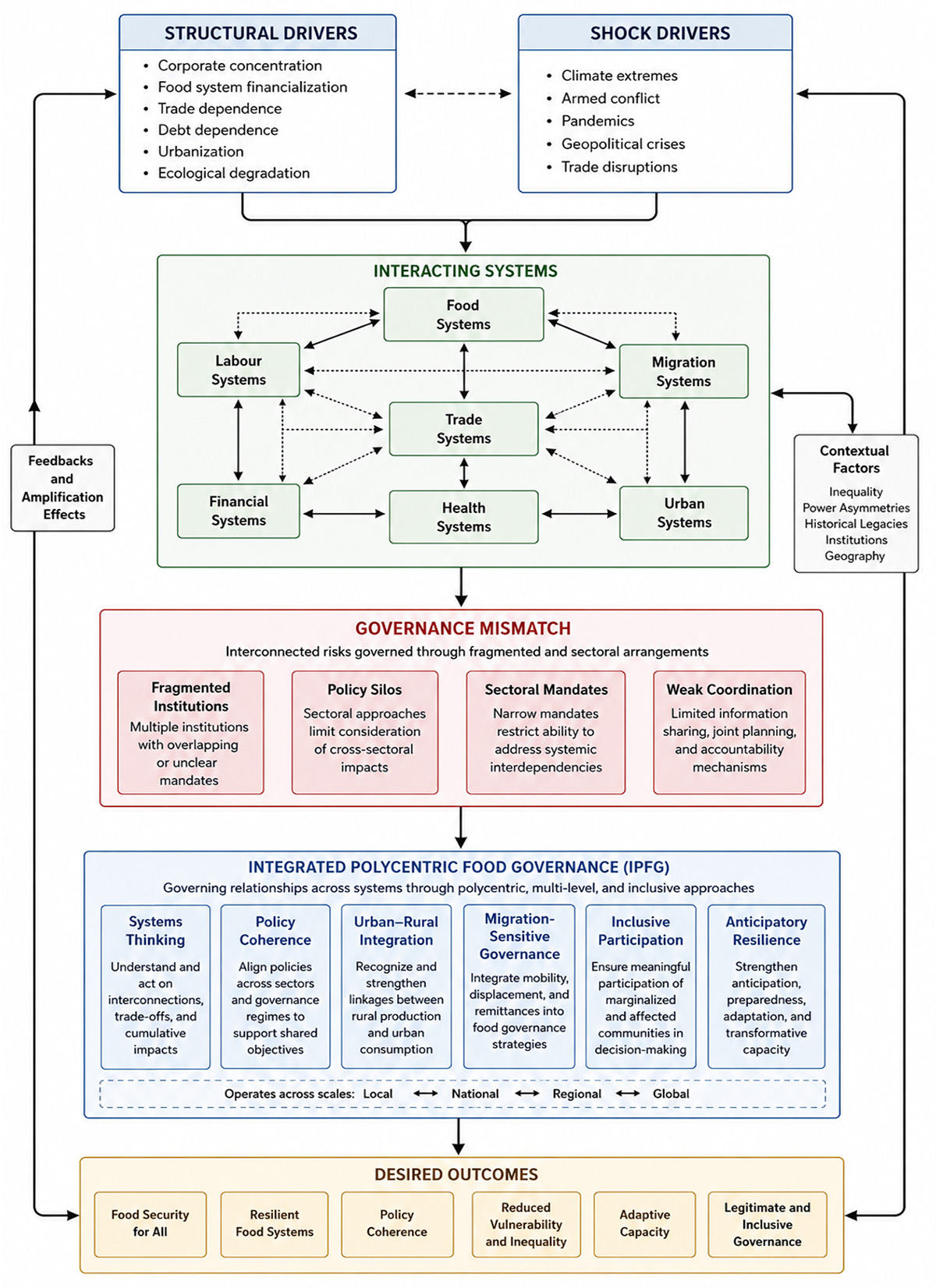
Figure 1 illustrates the framework’s analytical logic. Structural drivers and external shocks interact across food, labour, migration, trade, finance, health and urban systems, generating vulnerabilities that sectorally organized governance arrangements struggle to address. These interactions are conditioned by unequal power, historical legacies and institutional contexts. IPFG responds to the resulting governance mismatch through six interrelated dimensions.
Figure 1: Integrated Polycentric Food Governance
Source: Author’s synthesis.
The framework comprises six interrelated dimensions:
- Systems Thinking. Food insecurity emerges through interactions among environmental, economic, political and social processes. Systems thinking requires governance institutions to assess how decisions in one domain affect vulnerabilities in others, rather than addressing their consequences through isolated interventions.53
- Policy Coherence Across Governance Regimes. Institutional mandates and policy priorities frequently overlap or conflict. Policy coherence requires identifying these tensions and addressing the consequences of decisions across food, climate, migration, trade, humanitarian and development finance governance, including where institutional interests diverge.54
- Urban-Rural Integration. Food systems connect rural production and urban consumption through markets, labour, infrastructure and mobility. Integrating urban and rural governance requires recognizing these relationships in agricultural policy, urban planning, social protection and municipal decision making, rather than privileging production over access.55
- Migration-sensitive Food Governance. Migration shapes food production, distribution, livelihoods and household resilience. Recognizing migrants as workers, traders, entrepreneurs, consumers and remitters requires connecting food governance with migration, labour and social protection policies across jurisdictions.56
- Inclusive and Participatory Governance. Unequal power shapes whose interests influence food policy and whose knowledge is recognized. Meaningful participation requires extending influence over agenda setting, decision making and accountability to groups frequently marginalized within food governance, including small-scale producers, migrants, informal traders, women, youth and Indigenous communities.57
- Resilience and Anticipatory Governance. Responses to food crises must extend beyond managing immediate shocks to addressing the vulnerabilities that make their consequences unequal. Anticipatory governance links early warning, climate adaptation, social protection and livelihood diversification with efforts to reduce structural inequalities and strengthen preparedness across governance scales.58
IPFG therefore addresses the institutional and political dimensions of governance mismatch without centralizing authority or creating new institutions. It emphasizes cross-sectoral coordination, accountability and meaningful participation to address competing interests, unequal power and structural vulnerabilities. Its contribution lies in treating these challenges as interconnected rather than separate governance problems.
Conclusion
Food insecurity has long been rooted in unequal political and economic relations, but contemporary polycrises expose and intensify vulnerabilities across increasingly interconnected systems. This paper has conceptualized governance mismatch as the divergence between these systemic realities and governance arrangements shaped by sectoral mandates, competing interests and unequal power. The problem is not simply that institutions struggle to respond to interconnected crises; their rules, priorities and distributions of authority can also reproduce the conditions that make populations vulnerable. Urbanization, migration and mobility, and informal food systems reveal how these institutional and political limitations intersect across sectors and scales, often marginalizing the actors and practices on which everyday food security depends.
IPFG provides a framework for confronting this mismatch without assuming that centralization or institutional coordination alone can resolve it. Building on established scholarship, IPFG connects policy coherence and systems thinking with attention to mobility, urban-rural relationships, participation and anticipatory resilience. Its central implication is that effective food governance requires not only managing interdependencies across institutions and scales, but also confronting the power relations that determine whose interests shape policy, whose knowledge informs decisions, and whose vulnerabilities receive attention. The challenge is therefore not simply to make existing governance arrangements work together, but to reconsider how they exercise authority, distribute responsibility and reproduce or reduce food insecurity.