The war in Ukraine and sanctions on Belarus have disrupted global fertilizer supply chains, elevating the strategic importance of Canadian potash. Holding nearly one-third of global potash reserves, Canada’s reputation as a stable supplier uniquely positions it to strengthen its leadership in global food security. To seize this opportunity, Canada must address vulnerabilities in infrastructure, trade concentration and long-term supply security. Current export routes depend on congested rail and port infrastructure, creating bottlenecks and delays. Exports remain deeply concentrated in the United States, exposing Canada to geopolitical and trade risks amid an increasingly precarious bilateral relationship. Growing demand in Brazil, China, the European Union and India emphasizes the need to diversify markets and build durable partnerships that reinforce Canada’s global influence and leadership in food security.
Introduction
Canada is the world’s largest potash producer, with the majority of production concentrated in Saskatchewan’s Western Canadian Sedimentary Basin. Saskatchewan contains 11 major mines, while New Brunswick operates one small-scale mine.1 Valued at CDN$4.8 billion in 2021, potash is ranked Canada’s fourth mineral by value.2 Potash is considered a critical mineral, as 95 percent is used in fertilizers to support plant growth, increase crop yield and disease resistance, and enhance water preservation.3
Conservatively, Saskatchewan could supply the world’s potash demand at current levels for several hundred years.4 All 11 mines use conventional underground or solution mining methods for extraction. Conventional underground mining uses techniques such as drilling or blasting to create large caverns. Machinery is used to cut and remove ore, which is then transported to the surface for processing. Solution mining involves pumping superheated water into deposits, where it dissolves the target minerals. The liquid is then pumped to the surface, where it can be cooled, dried and processed.5
Four companies account for all potash production in Canada — Nutrien Ltd., The Mosaic Company, Compass Minerals and German fertilizer producer K+S Potash Canada — producing 22.9 million tonnes in 2024.6 BHP is advancing stages 1 and 2 of the Jansen mines in Saskatchewan. The Jansen project alone will increase Canadian production capability by 40 percent. The first stage will commence production in late 2026, yielding approximately 4.2 million tonnes of potash annually.7 The second stage is anticipated to start production in 2029 and reach 8.5 million tonnes annually when fully operational.8
These infrastructure constraints and opportunities align directly with recent federal priorities to strengthen trade-enabling infrastructure through initiatives such as the Trade Diversification Corridors Fund and the Major Projects Office. Northern, Eastern and Pacific port expansions associated with potash retrieval and exports represent shovel-ready candidates for a coordinated federal-provincial delivery, offering a clear pathway to reduce congestion, unlock new export routes and support sustained growth in non-US markets such as Brazil, the European Union and India.
Canada must address infrastructure bottlenecks, transportation constraints and weak supply chain coordination while diversifying their trade partners if they are to fully leverage its dominant position in potash production and capitalize on shifting global demand driven by geopolitical disruptions as tensions continue to occur.
Canada’s Dominance Amid Market Disruption and Price Dynamics
Canada has consolidated its position as the world’s leading potash exporter. In 2024, Russia and Belarus together accounted for 38.3 percent of the world’s potash exports, while Canada accounted for 38.7 percent alone.9 Driven by strong global demand and the disruption caused by Russia’s invasion of Ukraine, potash prices spiked to US$807 per tonne in 2021 and then to US$1,202 per tonne in April 2022.10 Prices have since fallen to US$372.50 per tonne as of February 2026,11 reflecting a partial easing of supply concerns. However, this decline does not indicate a return to pre-crisis conditions.12 Ongoing sanctions imposed by the European Union and allied countries on both Russia and Belarus continue to constrain global supply, suggesting that current market conditions remain structurally tight despite short-term price normalization.
Figure 1: World Exports of Potash (2024)
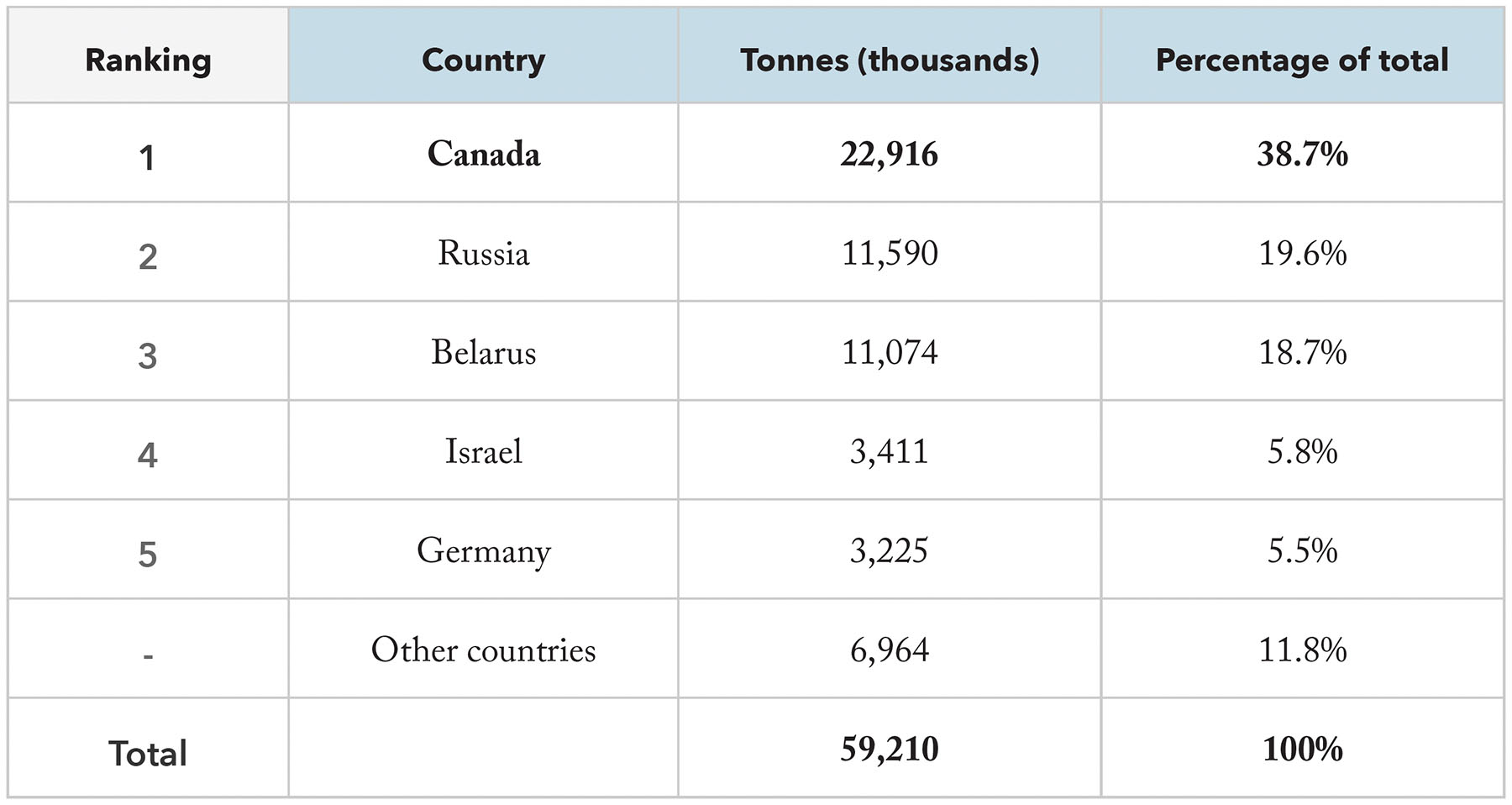
Source: Natural Resources Canada.13
Trade Dependence and Market Diversification
Despite this global advantage, Canada’s export structure remains deeply focused on the US market. Potash exceeds many Canadian exports since it benefits from tariff exemptions when traded under the Canada-US-Mexico Agreement (CUSMA).14 US potash production (less than one percent of global supply)15 cannot meet the needs of American farmers. To fill the gap, the United States imports 85 to 90 percent of its potash from Canada, drawing more than 12 billion kilograms from Saskatchewan in 2024.16 Canadian potash remains affordable and accessible for US farmers, mitigating fears expressed by the American Farm Bureau Federation (AFBF) that tariffs would increase their costs.17
Potash’s necessity in agriculture provides a unique advantage to Canada for trade negotiations. Alongside the AFBF, the Fertilizer Institute urged the Trump administration to exempt Canadian potash from the tariff order to maintain spring planting requirements and ensure harvests fill American dinner tables.18 The significance of the agricultural outcry deterred President Trump from imposing tariffs.
At the same time, emerging markets are reshaping global demand patterns. Brazil, China and India are the fastest growing potash markets. China has increased its reliance on Belarusian potash (exports surged from 17 percent in 2021 to over 70 percent in 2023) following intentional interference in exchange rates.19 Meanwhile, sales to the European Union and India collapsed entirely. India has reduced its dependence on imports by auctioning domestic potash reserves in Rajasthan.20 Brazil has cut Belarusian purchases of potash by about 50 percent21 but remains one of Canada’s largest customers (4.9 billion kilograms in 2024 worth nearly US$1.6 billion).22
With Brazil’s heavy reliance on imports for agriculture, Canada has the potential to consolidate or expand its market share. Expanding and securing long-term access to these markets would advance Canada’s export diversification agenda by increasing the share of potash exports bound for non-US vendors and markets as well as reducing exposure to a single dominant trading partner.
Geopolitical Implications
The war in Ukraine has significantly disrupted global fertilizer markets and raised concerns about food security worldwide, prompting several nations to reassess their import portfolios. With its vast supply, Canada has been the top contender to meet this demand and emerged as a significant player in stabilizing the market.
As geopolitical tensions continue to rise and the war in Ukraine intensifies, the European Union has become reliant on Canadian potash. Sanctions and export restrictions on Russia and Belarus have disrupted supply chains, forcing European countries to look elsewhere.23 Recent Group of Seven (G7) discussions have highlighted the importance of potash’s strategic role in fulfilling global potash shortages in nations such as India,24 and targeting adversarial market manipulations by China.25 Positioning Canada as a reliable potash exporter strengthens its standing as a trusted democratic ally, but infrastructure failures (outlined below) risk undermining these geopolitical gains.
Finally, Canada holds a competitive advantage in sustainable production. Canadian potash has lower greenhouse gas emissions than production in Russia and Belarus due to a greater reliance on clean energy grids, the adoption of sustainable mining technologies and stricter environmental regulations.26 Implementing “green potash” aligns with resilience, emissions reduction and enhances Canada’s competitive branding as the lowest-emission and most responsible producer. Green potash further supports environmental, social and governance-driven procurement in Brazil, the European Union and India.
Canada’s Infrastructure Constraints
Canadian potash production is concentrated in Saskatchewan, requiring long-distance transportation to reach export markets. Rail transportation represents the backbone of Canada’s potash export system, but also its most significant constraint. Approximately 75 percent of potash travels over 2,000 km by rail to coastal ports, primarily on the West Coast, before being shipped internationally.27 Current volumes already place considerable strain on this network. Canpotex trains make approximately 700 trips annually to transport potash to ports, with each train carrying roughly 17,500 tonnes.28 Future production growth will further intensify this pressure.
The Jansen project, yielding 4.2 million tonnes, may alone require an additional 247 trains annually to respond at full capacity, representing a substantial increase in rail demand on an already constrained system. These constraints are compounded by the fact that potash shipments share rail infrastructure with other bulk commodities. Disruptions to rail service already carry significant economic consequences, with losses estimated at up to CDN$63 million per day.29
Port infrastructure presents a second critical constraint on Canada’s potash export system. Exports are largely routed through West Coast terminals, particularly Vancouver and Prince Rupert, which together handle over 335 million tonnes of cargo annually and are approaching capacity limits.30 This concentration of export flows through a limited number of high-volume ports creates significant throughput constraints; port disruptions alone are estimated to result in daily losses of up to CDN$9.7 million.31
Critically, Canada’s potash transportation challenge is not limited to individual constraints in rail or port infrastructure but arises from the structure of the system. This interdependence means that constraints at any point in the system, whether rail congestion, limited terminal capacity or delays in ship loading, can generate cascading effects. In 2025, Nutrien announced plans to develop a new potash export terminal at the Port of Longview, Washington, citing strong rail connectivity, deep-water access and construction feasibility.32 This shift highlights a critical risk: without sufficient investment and coordination, Canada’s internal chokepoints could contribute to the private sector’s relocation of export logistics outside its borders.
Figure 2: Canada’s Transport Corridors
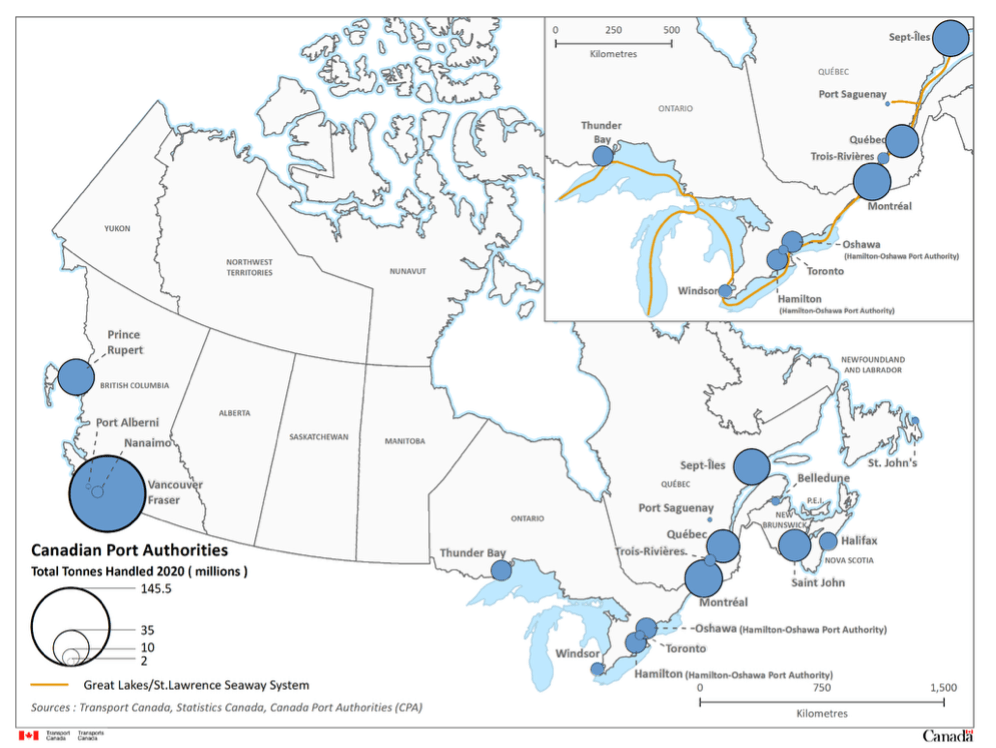
Source: Transport Canada.33
Currently, Canada’s potash export system relies on three primary transportation corridors, each with distinct roles and constraints. The dominant West Coast export corridor entails transportation by rail from Saskatchewan to West Coast ports, where it is shipped to global markets, principally in Asia. While this route benefits from established infrastructure and high throughput capacity, its heavy utilization creates systemic congestion risks.
Canada’s only deep-water Arctic port has recently received CDN$262.5 million34 from the federal government and Manitoba aimed to reposition the Churchill port as a strategic export gateway. This route offers a shorter rail distance from Saskatchewan to tidewater and more direct access to European and African markets. While this corridor could alleviate pressure on West Coast infrastructure and enhance route diversification, it remains underdeveloped and seasonally constrained.
Baseline and Performance Metrics
The current baseline system is defined by a high degree of concentration, limited excess capacity and strong dependence on long-distance rail transport. In 2024, Canada exported approximately 22.8 million tonnes of potash valued at CDN$11.6 billion dollars.35 This supply chain was supported by roughly 700 annual train movements and a logistics system in which approximately 75 percent of production relies on rail transport over distances exceeding 2,000 km. This volume is largely funnelled through a small number of West Coast terminals that are already operating near capacity.
These indicators point to a system with limited surge capacity and a high sensitivity to disruption. Existing infrastructure must simultaneously accommodate growing production volumes, concentrated export flows and shared usage across multiple commodities. The economic consequences of these constraints are already evident, with rail disruptions resulting in losses of up to CDN$63 million per day36 and port disruptions costing up to CDN$9.7 million daily.37
Recommendation
Canada should adopt an integrated potash infrastructure expansion and national potash security strategy. Such a strategy aligns with infrastructure investment, trade diversification and resilience, planning to help ensure that increased production capacity translates into sustained export growth and long-term market leadership to prevent supply disruptions. The goal is to drive dependable export and transportation capacity, secure long-term market access, and safeguard Canada’s role in global food security. This strategy rests on three pillars.
Pillar One: Expanding, Modernizing and Aligning Infrastructure Capacity
Canada’s ability to scale potash exports is increasingly constrained by transportation and logistics bottlenecks. Canada should prioritize expanding and modernizing transportation infrastructure to address existing bottlenecks and align capacity with projected production growth.
This includes co-financing major rail and port upgrades through the Major Projects Office as the central delivery mechanism for addressing blockages between Saskatchewan and tidewater. This office would coordinate approvals, financing and timelines to then accelerate construction, reduce regulatory delays and ensure that new transportation capacity is aligned with unannounced mine expansions and federal infrastructure priorities.
Canada should also assess whether northern ports such as Churchill can be incorporated into long-term export routes. This includes determining how existing rail infrastructure could be reinforced to handle higher volumes and ease pressure on westbound lines. At the same time, the federal government, working with private terminal developers including those in the Pacific Northwest, could also provide matched funding and faster permitting timelines while maintaining environmental and consultation requirements.
In addition to major infrastructure investments, improving system efficiency is critical. Canada should invest in renewing railcar fleets and expanding maintenance capacity to boost per-train volumes and shorten turnaround times for potash shipments.
Pillar Two: Trade Partnerships — Secure Long-term Markets and Favourable Terms
To support the Government of Canada’s objective of doubling exports to non-US markets over the next decade, Canada should secure long-term offtake arrangements and deepen trade partnerships, with priority growth markets such as Brazil, the European Union and India as well as selected Indo-Pacific buyers.
Anchoring new production capacity through multi-year agreements would reduce market volatility, strengthen export diversification and enhance Canada’s position as a dependable long-term supplier. Additionally, maintaining strong trade relations with the United States remains crucial given their continued dependence on Canadian potash.
Canada should leverage trade frameworks such as CUSMA and the Canada-European Union Comprehensive Economic and Trade Agreement (CETA) to defend tariff exemptions and secure more favourable non-tariff provisions, reducing administrative barriers for agricultural import agencies. As of 2017, CETA has served to eliminate 98 percent of EU tariff lines and streamline regulatory procedures to boost Canadian competitiveness in the European Union.38 By systematically reducing trade barriers across sectors, the bilateral agreement provides Canadian businesses with market stability and preferential access to European clients. Supporting Canadian firms through trade missions, buyer round tables and technical assistance will also be critical in navigating state-led procurement systems in key markets.
Pillar Three: National Potash Security — Resilience, Reserves and Sustainability
Canada should introduce a national potash resilience framework to strengthen the sector’s ability to manage disruptions and maintain reliability in global markets.
This includes incorporating strategic buffer stocks or rapid deployment allocation systems to manage short-term disruptions and maintain buyer confidence. Investments in processing, storage and logistics through targeted incentives, including time-limited subsidies and tax credits tied to strong environmental performance.
Canada must work with G7 partners to establish shared fertilizer security principles, strengthen information sharing and coordinate contingency planning to ensure stable global access to potash. Simultaneously advancing Canada’s leadership in sustainable potash production will be essential for long-term competitiveness.
This includes supporting research and development in lower-emission extraction, improving lifecycle emissions reporting and accelerating assessments for projects that meet high environmental standards. Canada’s existing advantage in cleaner energy and stronger environmental regulation (compared to Russia and Belarus) should be leveraged to position Canadian potash as a competitive green option in global markets.
Implementation: Financing, Governance and Accountability
Implementation should be supported through a coordinated approach to financing, governance and performance monitoring.
A blended mix of federal loan guarantees, low-interest infrastructure loans, tax-efficient co-investment and public-private partnerships should be used to reduce project risk while leveraging private capital. Time-limited capital cost rebates or accelerated capital cost allowances can further incentivize investment in rail and terminal infrastructure, which would demonstrate measurable growth.
The Major Projects Office should serve as a central coordinating body, supported by federal-provincial-industry collaboration to align approvals, reduce administrative delays and ensure infrastructure timelines match production growth and demand. Additional coordination within trade focused departments will support alignment between market access objectives and industry needs.
Progress of this project should be tracked through clear metrics. This would include reductions in transportation bottlenecks, increases in export capacity, diversification of export markets and the share of production secured through long-term agreements.
Cost Estimates for Implementation
The cost estimate of this proposal is indicative and derived using a comparative benchmarking approach. Estimated ranges are based on publicly available data from analogous Canadian and international infrastructure, trade and resource policy initiatives. Where cost data was not directly applicable, proportional scaling and program-level comparisons were applied to approximate expected expenditures. All figures should therefore be interpreted as order-of-magnitude estimates rather than precise budget projections.
The projected cost of implementing this proposal is estimated at approximately CDN$4 billion to CDN$6.6 billion over the course of the implementation period. The largest share of expenditure would be directed toward infrastructure expansion, with estimated costs of CDN$3.75–$6.1 billion, reflecting the substantial capital requirements of large-scale rail, port and terminal upgrades (CDN$2.5–$4.0 billion)39, 40 to be supported by federal co-financing arrangements (CDN$750 million–$2 billion).41 Trade diversification measures would require a comparatively smaller investment of CDN$150–$400 million, covering trade diplomacy, market access programming,42, 43 coordination capacity,44 and export support45, 46 The national potash security component is estimated at CDN$350–$700 million, driven by the establishment of a strategic reserve system (CDN$200–$400 million)47 and incentives for private-sector investment and innovation.48 Overall, the proposal represents a significant fiscal commitment at approximately CDN$4–6.6 billion, with total costs weighted toward capital-intensive infrastructure needed to support long-term supply resilience and export capacity.
Conclusion
The prime minister’s mandate and Budget 2026 prioritize trade diversification, supported by the Trade Diversification Strategy and the Trade Diversification Corridors Fund, which allocates resources to new ports, airports and railway infrastructure. Much of the proposed infrastructure and coordination can be implemented through existing programs and the Major Projects Office.
This strategy is expected to deliver measurable economic benefits for Canadians, including the creation of thousands of well-paying jobs in the mining, construction, transportation and technology sectors. Since 2019, jobs associated with the extraction and production of critical minerals in Canada have grown by 6.2 percent to reach nearly 55,000 jobs in 2022, highlighting the sector’s significant contribution to employment.49 These investments are projected to strengthen regional economies, particularly in Western Canada, generate substantial new revenue and expand supply chain opportunities across the country. In the context of global uncertainty, advancing trade diversification and infrastructure capacity is essential for long-term economic stability, reducing dependence on a single trading partner and reinforcing Canada’s role as a secure and reliable global supplier.